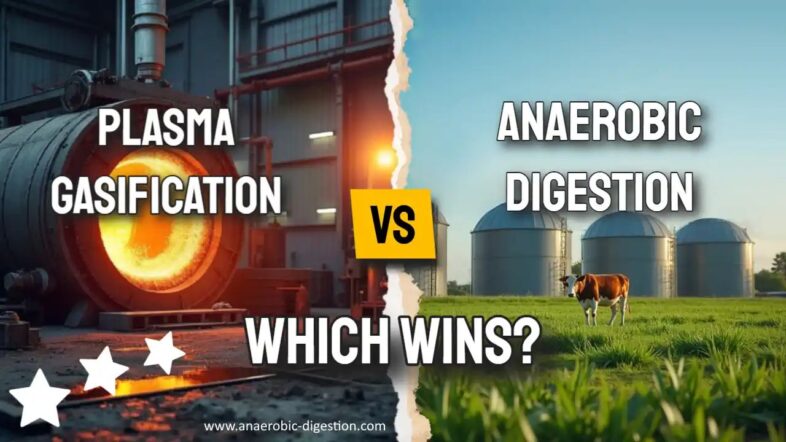
Plasma gasification and anaerobic digestion (AD) are distinct waste-to-energy technologies. Plasma gasification uses extreme heat o convert mixed waste (plastics, hazardous waste) into syngas and inert slag. Anaerobic digestion uses microorganisms to break down wet organic waste (food, manure) into biogas and digestate.
Summary of Points Covered for Plasma Gasification vs Anaerobic Digestion
- Plasma gasification reaches temperatures up to 14,000°C, converting nearly any waste type — including hazardous materials — into syngas with a 99% conversion rate for plastics.
- Anaerobic digestion is the smarter choice for organic-heavy waste streams, producing biogas with 50–70% methane content and leaving behind digestate that works as a natural fertiliser. Plasma gasification is better for mixed dry waste, such as municipal waste.
- The global waste-to-energy market is growing fast, projected to climb from $45.89 billion in 2025 to $70.2 billion by 2032 — and both technologies are competing for a slice of that growth.
- Cost and scale are the biggest barriers separating these two technologies, with plasma gasification facing steep operational expenses that have kept commercial deployments to just five sites worldwide.
- One technology clearly fits developing nations better than the other — and the answer might surprise you if you've only been looking at raw energy output numbers.
Two Technologies, One Goal: Turning Waste Into Power
The world generates over 2 billion tons of municipal solid waste every year, and how we deal with it is one of the most consequential sustainability decisions of our time.
Plasma gasification and anaerobic digestion are two vastly different solutions to the same pressing problem: how can we convert waste into something beneficial instead of burying it in the ground?
One employs intense heat to vaporise almost any substance on the planet. The other depends on microscopic organisms silently performing their million-year-old duties. Both generate energy. Both decrease landfill reliance. However, they cater to very different waste streams, budgets, and infrastructure scenarios. Selecting one over the other isn't merely a technical choice — it's a strategic one.
If you work in waste management, city planning, or sustainable infrastructure, it's crucial to understand the practical trade-offs between these two technologies. More and more resources are becoming available on waste-to-energy innovation, including breakdowns of different technologies, through organisations that are dedicated to promoting circular economy solutions.

“Plasma gasification of municipal solid …” from link.springer.com and used with no modifications.
Understanding Plasma Gasification
Plasma gasification is a thermal procedure that employs plasma arcs, which are electrically generated, to transform waste into a flammable gas known as syngas. Rather than burning waste as incineration does, it breaks it down on a molecular level.
The Role of Plasma Arc Temperatures in Waste Destruction
Temperatures that range from 3,000°C to 14,000°C are produced by a plasma arc torch, which is hotter than the sun's surface. At such extreme temperatures, the molecular bonds in almost any material are completely broken down. Organic compounds are vaporized into their basic elements, while inorganic materials such as metals and silicates are melted into a heavy, glass-like slag.
This isn't just heat — it's thermal destruction at the atomic level. The process happens inside a sealed gasification chamber, which means almost no direct combustion emissions escape during the primary conversion stage. That's a critical distinction from traditional incineration, where direct burning releases a far more complex mix of pollutants. State-of-the-art gasification technologies have improved energy efficiency by 25% and reduced emissions by something like 40% compared to older thermal treatment systems.
Understanding Syngas and Its Role in Power Generation
The main product of plasma gasification is syngas — a gas primarily composed of hydrogen (H₂) and carbon monoxide (CO). This gas is flammable and can be used in several different applications:
- Directly burned in gas turbines or engines to produce electricity
- Transformed into synthetic natural gas or liquid fuels
- Utilised as a chemical feedstock for industrial production
- Further refined into hydrogen fuel
Modern plasma gasification systems can generate 500 to 600 kWh of electricity from each ton of waste processed. This energy yield provides real economic value beyond just diverting waste — it makes plasma gasification a real asset for power generation, not just a method of disposal. Additionally, innovative approaches like CO2 capture contribute to the viability of waste-to-energy technologies.
The Reason Behind the Limited Number of Commercial Plasma Facilities Globally
Although plasma gasification is technically proficient, it has had difficulty scaling up commercially. At present, there are only five commercial-scale plasma gasification facilities operating worldwide, each processing approximately 200 tons of waste each day. The primary reason for this is the cost. The plasma arc torches use a significant amount of electricity to maintain operational temperatures, resulting in a difficult energy-in versus energy-out equation that necessitates meticulous system design to remain net-positive.
The upfront costs of a plasma plant are much higher than those of an anaerobic digestion plant of the same size. The technology requires specialized engineering, materials that can withstand very high temperatures, and operators with specific skills. These obstacles have meant that plasma gasification is mainly used in government-supported demonstration projects and specialized applications like destroying hazardous waste.
However, the continuous development of plasma torch efficiency and system integration are gradually enhancing its economic viability. The technology isn't failing, it's growing. But for now, its commercial presence is still limited compared to its theoretical potential.
Anaerobic Digestion: An Overview
Anaerobic digestion (AD) is a natural process where microbes consume organic matter in an oxygen-free environment, yielding biogas and a nutrient-dense solid known as digestate. This process, which is one of the oldest on the planet, has been harnessed by modern engineering to create a dependable waste-to-energy solution.
The Process of Microorganisms Breaking Down Organic Waste Without Oxygen
In a closed digestion tank, the process of converting complex organic molecules into simpler compounds happens in four stages — hydrolysis, acidogenesis, acetogenesis, and methanogenesis. The last stage, methanogenesis, is where the methane-producing archaea create the biogas that makes the whole process economically viable. The process usually takes 15 to 30 days depending on the type of feedstock and the operating temperature. Mesophilic systems operate at about 35°C, while thermophilic systems work at 55°C for faster throughput and better pathogen destruction.
Understanding the 50–70% Methane Content in Biogas
When raw biogas is produced through anaerobic digestion, it contains 50–70% methane. The rest of the biogas is mainly carbon dioxide and trace gases. This methane concentration is high enough to generate electricity directly through combined heat and power (CHP) engines. It can also be upgraded to biomethane, which is a renewable natural gas that is virtually identical to fossil-derived pipeline gas. The process of upgrading removes the CO₂ and achieves a methane purity above 97%. This makes it possible to inject the biogas into the national gas grid or use it as vehicle fuel. The versatility of biogas is a major reason why anaerobic digestion has seen far wider commercial deployment than plasma gasification.
Power Production: Which Technology Produces More?
Raw power output figures paint part of the picture, but the type of feedstock and the design of the system shape the real-world results for both technologies.
Energy Production from Plasma Gasification per Ton of Waste
When a plasma gasification system processes mixed municipal solid waste, it produces about 500–600 kWh of electricity per ton. This amount remains fairly steady regardless of the type of waste because the intense heat destroys the variability in the feedstock — whether it's plastics, textiles, medical waste, or mixed garbage, they're all transformed at a 99% conversion rate for high-polymer materials like plastics. But to figure out the net generation, you need to subtract the parasitic energy load of the plasma torches themselves from the total output, which reduces the actual return on energy investment.
Energy Yields Per Ton of Waste from Anaerobic Digestion
Anaerobic digestion can generate 100 to 300 kWh of electricity equivalent per ton of organic waste treated. This largely depends on the methane yield of the specific feedstock. For instance, food waste produces much more biogas than woody agricultural residues. When the biogas is utilized in a CHP unit with an electrical efficiency of 35–40%, the power output per ton is less than plasma gasification. However, the overall system economics are much more favorable due to the significantly lower operational costs.
It's important to remember that AD also provides benefits beyond just electricity. The digestate byproduct can replace synthetic fertilizers, which provides an extra source of income or cost-offset that the vitrified slag from plasma gasification can't easily match in agricultural settings.
The Importance of the Type of Waste
The most significant factor when comparing plasma gasification and anaerobic digestion isn't the technology itself, but rather the type of waste that each process uses. Plasma gasification can handle almost any type of waste, even if it's mixed, contaminated, or hazardous, which would kill the microorganisms in an anaerobic digester. On the other hand, anaerobic digestion works best with specific types of organic waste and doesn't perform well when it's fed waste that falls outside of its biological capabilities.
The dependency on feedstock explains why the two technologies are not often directly competitive. A city with a high proportion of organic household waste and a city dealing with industrial mixed waste with a high plastic content will come to very different conclusions when assessing which system is best suited to their waste profile. Getting this analysis right before committing to infrastructure is the difference between a successful waste-to-energy project and an expensive underperformer.
Building and Operating Costs
The most critical factors that municipalities and private operators consider when choosing between these technologies are capital and operational costs. Plasma gasification and anaerobic digestion are at opposite ends of the cost spectrum. To understand why, we need to examine what each system requires to function daily.
It is expected that the worldwide waste-to-energy market will expand from $45.89 billion in 2025 to $70.2 billion in 2032. This suggests that both technologies are attracting more investors. However, the inherent cost disparities in each system's design are not eliminated by the availability of funding.
The High Costs of Operating Plasma Facilities
Plasma gasification facilities are much more expensive to run than other waste-to-energy technologies. The plasma arc torches alone require a constant supply of high-voltage electricity to maintain operational temperatures, which results in a substantial and unavoidable parasitic energy load. The refractory linings inside the gasification chamber — materials designed to withstand temperatures over 3,000°C — require regular replacement and specialist maintenance teams. These costs are not optional; they are inherent to the operation of the technology.
There are also operational challenges to consider. Plasma systems need highly skilled engineers, real-time monitoring of the syngas composition, and advanced gas cleaning systems to remove tars and particulates before the syngas is used in power generation equipment. When you take into account the current commercial reality — facilities processing only 200 tons per day — the cost-per-ton economics continue to be difficult without substantial government backing or tipping fee revenue from hazardous waste contracts.
Anaerobic Digestion: A More Affordable Option
When it comes to costs, anaerobic digestion plants take the cake. These facilities are not only less expensive to build, but they're also cheaper to operate and maintain. A community-sized anaerobic digestion plant that processes food and organic waste can be built for a fraction of the price of a plasma gasification plant with the same capacity. The operational costs are also lower because the biological process is self-sustaining once it gets going — the microbes do all the work converting waste into energy, without needing a constant supply of high-energy inputs. The financial case for anaerobic digestion is made even stronger by the potential revenue streams from selling biogas, injecting biomethane into the grid, and selling the digestate as fertilizer. This makes anaerobic digestion projects attractive to private investors, without needing the level of subsidies that plasma facilities often rely on.
The Effect on the Environment: Emissions, Waste, and Land Use
Both methods are much better for the environment than using a landfill, but they each have a unique environmental impact. The best option depends on what environmental factors are most important in a particular situation — whether that's reducing air pollution, preventing methane leaks, recycling nutrients, or getting rid of toxic waste.
What Makes Plasma Gasification's 99% Conversion Rate So Effective?
Plasma gasification's near-complete destruction of organic compounds is one of its most environmentally friendly aspects. At operating temperatures above 3,000°C, persistent organic pollutants like dioxins and furans are destroyed before they can form stable compounds. The 99% conversion rate for plastics means that high-polymer waste — one of the most harmful types of waste to the environment — is almost entirely converted to usable syngas, leaving virtually no residual solid waste.
After the plasma gasification process, the main byproduct is vitrified slag — a dense, inert, glass-like substance created from the melted inorganic parts of the waste. This slag is chemically stable, doesn't leach, and is considered non-hazardous by most regulations. It can be reused as:
- Road construction aggregate and sub-base material
- Construction fill for building foundations
- Ceramic and tile manufacturing feedstock
- Abrasive material in industrial applications
The combination of near-zero organic residue and inert slag means plasma gasification produces the smallest hazardous waste footprint of any thermal treatment technology currently in commercial operation. Modern systems also achieve an 80–95% reduction in waste volume and a 70–80% reduction in waste mass, dramatically cutting the land use burden associated with residue disposal.
Organic Fertilizer From Anaerobic Digestion Digestate
Anaerobic digestion doesn't just get rid of solid waste — it changes it. The digestate left over after the microbes have done their work is a semi-solid substance full of nitrogen, phosphorus, and potassium, the three main nutrients needed for farming. When it's treated right and quality-checked, digestate can be used instead of man-made fertilizers, making a real circular economy loop between city food waste and farmland.
The ability to recover nutrients gives anaerobic digestion an environmental edge that plasma gasification just can't compete with. The production of synthetic fertilizer is a process that's heavy on energy use and carbon emissions. Every ton of digestate used on farmland instead of synthetic options means a measurable decrease in upstream emissions. This is a benefit that doesn't often show up in basic energy output comparisons between the two technologies, but it's ecologically important on a large scale.
Comparing Greenhouse Gas Reductions to Traditional Landfill Methods
Both plasma gasification and anaerobic digestion technologies offer substantial reductions in greenhouse gas emissions when compared to traditional landfill methods. Modern waste-to-energy systems, which include both of these technologies, have been shown to reduce greenhouse gas emissions by 30–87% when compared to conventional waste disposal methods. This range is so broad because it depends on the specific landfill being used as a baseline. For example, an unlined landfill with no gas capture would represent the worst case scenario, while a well-managed landfill with active gas recovery would represent a much more favorable scenario.
There is one significant greenhouse gas issue with anaerobic digestion: methane leakage. Methane is about 80 times more potent than CO₂ over 20 years as a greenhouse gas. Any fugitive methane emissions from poorly sealed digesters or inadequate biogas capture systems can quickly negate the climate benefit of the technology. Plasma gasification does not have this risk — its sealed, high-temperature process does not produce methane as an intermediate product. AD facilities that are well designed and have rigorous leak detection maintain strong climate credentials, but it is a management variable that plasma gasification does not have to deal with.
Which Waste Types Each Technology Handles Best
Choosing the correct technology for the right waste stream is not only good practice — it's the basis of a cost-effective and environmentally friendly waste management system. Both plasma gasification and anaerobic digestion have clear advantages, and both have strict limitations that dictate where they fit in a waste hierarchy.
Plasma Gasification and Handling Mixed or Hazardous Waste
When it comes to dealing with complicated, contaminated, or dangerous waste, plasma gasification is the go-to technology. Medical waste, materials containing asbestos, residues from chemical plants, and unsorted municipal solid waste with a high content of plastic and synthetic materials are all suitable for plasma treatment. The high temperatures not only neutralize biological hazards and destroy chemical toxins, but also process mixed feedstocks without the need for sorting and pre-processing, something most rival technologies require. This makes plasma gasification a particularly useful tool for dealing with waste that would be illegal or technically impossible to process using biological or lower-temperature thermal systems.
Another advantage of the technology is its ability to significantly reduce waste volume. Facilities can achieve an 80–95% volume reduction, which can greatly prolong the lifespan of existing landfill capacity. This is particularly important in densely populated areas where land is at a premium and expanding landfill capacity is either politically or geographically unfeasible.
Why Anaerobic Digestion is Popular in Developing Countries
Anaerobic digestion is a natural choice for developing countries due to the makeup of their waste streams. Study after study has found that 50–56% of waste in developing countries is food and garden organic waste — the very high-moisture, high-organic-content feedstock that anaerobic digestion handles best. The economic and infrastructure requirements of plasma gasification, on the other hand, are not compatible with the financial limitations and technical abilities of most lower-income municipalities.
- AD's lower capital and operational costs make it feasible without significant government subsidies
- Biogas can provide immediate local energy for cooking and heating
- Digestate directly supports small-scale farming, reducing the cost of importing fertilizers
- Community-scale AD systems can be implemented without grid infrastructure
- Technology transfer and training requirements for operators are significantly lower than for plasma systems
The practical benefits are quickly multiplied at the community level. A small-scale AD unit that processes food waste from a district market can supply biogas for cooking fuel to dozens of households while producing fertilizer for nearby farms. This kind of decentralized, multi-benefit deployment is simply not replicable with plasma gasification at equivalent scale and cost.
It's important to mention that poor logistics, education, and finance are still documented barriers to implementing waste-to-energy in developing countries. Anaerobic digestion's lower complexity and well-established technology transfer pathways give it a structural advantage in overcoming these barriers — whereas the complex engineering requirements of plasma gasification can make them even worse.
Scaling Up: Where Each Technology Stands in 2025
- Plasma gasification is still limited to five commercial facilities worldwide, each handling about 200 tons of waste per day
- Anaerobic digestion is widely used across Europe, Asia-Pacific, and parts of Sub-Saharan Africa
- The global waste-to-energy market is expected to reach $70.2 billion by 2032, boosting investment in both technologies
- AI-driven process optimization is enhancing operational efficiency in both platforms
- Incineration still leads with over 1,700 plants operational worldwide, but AD and plasma are slowly gaining traction in specific niches
Scaling waste-to-energy technology from a pilot project to commercial infrastructure is often the biggest hurdle for most innovations. Both plasma gasification and anaerobic digestion have demonstrated their technical feasibility in controlled environments, but translating that into reliable, large-scale deployment involves navigating a complex combination of policy support, private investment, public acceptance, and engineering maturity.
At this point, the difference between the two technologies couldn't be more obvious. Anaerobic digestion has been commercially successful in dozens of countries and is now considered a mature technology in many regulatory frameworks. Plasma gasification, on the other hand, is still striving to achieve that status, with its commercial deployment count still in the single digits despite decades of development. This gap reflects real differences in cost, complexity, and risk tolerance — not a fundamental flaw in plasma technology itself.
Both systems are being revolutionized by the combination of digital automation, enhanced materials engineering, and increasing regulatory pressure to keep waste out of landfills. Governments in the European Union, Southeast Asia, and parts of North America are enforcing stricter landfill restrictions and broadening renewable energy requirements, thus creating policy conditions that directly encourage large-scale waste-to-energy investment. Both technologies are poised to profit, but in different markets and for different types of waste.
Current Plasma Arc Projects Are Still Processing Less Than 200 Tons Daily
All currently operating commercial plasma gasification facilities process 200 tons or less of waste per day, according to Wikipedia in 2009. Our research suggests that figure has not been surpassed even now in 2026.
That throughput figure reflects both the high capital cost of scaling plasma systems and the energy intensity of maintaining arc temperatures continuously across larger chamber volumes. Increasing throughput isn't simply a matter of building a bigger reactor; it requires proportionally more plasma torch capacity, more robust gas cleaning infrastructure, and more sophisticated control systems to maintain syngas quality across a larger and more variable feedstock flow. Projects currently in development are pushing toward higher throughput targets, but until those facilities reach commercial operation, 200 tons per day remains the practical ceiling for proven plasma gasification installations.
Rolling Out Anaerobic Digestion in Asia-Pacific
In contrast to the lack of progress in gasification technology, the anaerobic digestion industry has been growing since the mid-2000s, and is now becoming large enough to be a significant player in the renewable energy sector.
The Asia-Pacific region is leading the way in anaerobic digestion expansion, thanks to fast-paced urbanisation, an increase in organic waste, and renewable energy goals in countries like China, India, South Korea, and Australia.
China has poured a lot of money into large-scale biogas infrastructure, making AD systems a part of agricultural waste management at the national policy level. India's Smart Cities Mission has included decentralised AD units in urban waste planning in several municipalities, turning food market waste into biogas for street lighting and cooking fuel.
South Korea is a world leader in the deployment of Anaerobic Digestion (AD) technology. The country outlawed the direct landfilling of organic waste, which sped up investment in biological treatment infrastructure. Today, Korean facilities combine AD with composting and biomethane upgrading, showing us what a fully optimised organic waste treatment system looks like on a national scale.
In Australia, there has been an increase in the use of AD systems on farms and in food processing plants. Several facilities are now injecting biomethane directly into the gas distribution network. The revenue from injecting into the grid, tipping fees from organic waste processing, and sales of fertiliser from digestate have produced viable commercial returns without heavy reliance on subsidies. This model is being actively studied and replicated in other markets in the Asia-Pacific region.
How Technology is Enhancing Both Systems
Technology is changing the way we operate plasma gasification and anaerobic digestion. For plasma systems, real-time monitoring of syngas composition allows operators to adjust torch power, feedstock feed rates, and gas cleaning parameters dynamically, improving net energy output and reducing the frequency of unplanned shutdowns. Predictive maintenance algorithms are also extending the service life of refractory linings and plasma torch components — two of the highest-cost maintenance items in plasma facility operations.
Artificial intelligence and continuous monitoring of important process parameters can help to prevent digester failure, which is one of the most expensive operational risks in anaerobic digestion. Automated feedstock mixing systems may also be used to optimise the carbon-to-nitrogen ratio in real time, which can improve methane yield without the need for manual intervention. These improvements are helping to reduce operational costs and improve the reliability of anaerobic digestion facilities, making them more appealing to private investors who require predictable performance metrics in order to finance projects.
Plasma Gasification vs Anaerobic Digestion: The Final Say
There isn't a one-size-fits-all solution here — any analysis that definitively ranks one technology above the other is neglecting the crucial influence of waste composition, local infrastructure, budget limitations, and policy context in deciding the most appropriate fit.
Plasma gasification is the best solution when the waste stream is mixed, hazardous, or high in plastics and synthetics, and when the operational context can accommodate its higher cost base. Its near-total eradication of toxic materials, inert slag output, and feedstock flexibility make it uniquely equipped for industrial and high-complexity waste management challenges. Anaerobic digestion is the clear winner when the waste stream is mainly organic, when budget and infrastructure limitations are significant, and when the aim is to recover nutrients in addition to producing energy. Its lower cost, demonstrated scalability, and circular economy credentials make it the most feasible technology for the majority of the world's waste challenges at present.
For most planners, the key question isn't which technology is better — it's which technology is the right fit. In many advanced waste management systems, the answer will eventually be both: plasma gasification will handle the residual, non-recyclable, and hazardous fractions that biological systems cannot process, while anaerobic digestion will manage the large organic fraction efficiently and cost-effectively. A complementary deployment strategy that matches each technology to its optimal waste stream isn't just a sound theory — it's the direction that the most sophisticated waste management systems in the world are already heading.
Common Questions
Plasma gasification and anaerobic digestion are two technologies that have piqued the interest of engineers, policymakers, and sustainability professionals who are trying to navigate the increasingly complex landscape of waste-to-energy. The questions below address the most common points of confusion and comparison between the two technologies.
Grasping the real-world differences, not just the theoretical possibilities, of each system is the difference between a successful waste strategy and a costly mistake. Here are the answers to the most important questions.
Is Plasma Gasification Capable of Processing All Waste Types?
Plasma gasification can handle almost all types of solid waste, including municipal solid waste, medical and clinical waste, hazardous chemical waste, asbestos-containing materials, and waste streams with high plastic content. Its operating temperatures, which can reach up to 14,000°C, are high enough to destroy the molecular structure of virtually all organic compounds, including persistent organic pollutants that lower-temperature systems cannot eliminate. The main practical limitation is not the type of material, but the moisture content: extremely wet feedstocks reduce the net energy output because a significant portion of the system's thermal energy is used to evaporate water instead of gasifying solid material. This can be addressed by pre-drying or blending the feedstock, but it adds complexity and cost to the process. For more information on waste-to-energy technologies, you can read this article on next-generation projects reshaping power generation.
Can Anaerobic Digestion be used in Urban Areas?
Yes, anaerobic digestion is a perfect fit for urban settings. It can handle food waste that has been separated at the source, organic waste from restaurants and catering services, and sewage sludge from wastewater treatment plants. When properly designed and managed, modern enclosed AD facilities produce very little odor. Compact modular systems can be placed in urban industrial zones. A number of large cities, such as Amsterdam and Seoul, have AD facilities that are a direct part of their urban waste management infrastructure.
The key to successfully implementing anaerobic digestion in urban areas is to have an efficient source separation system that keeps organic waste streams free of plastic, glass, and non-biodegradable material contamination. Contaminated feedstock reduces biogas yields and can introduce problematic compounds into the digestate, limiting its agricultural application. Cities that have invested in household food waste separation programs consistently report better AD plant performance and higher-quality digestate output than those relying on mixed waste separation after collection.
Which Method is Greener?
Both methods are significantly greener than traditional landfilling, reducing greenhouse gas emissions by 30–87% compared to conventional disposal. Plasma gasification has the advantage of eliminating toxic residues and persistent organic pollutants, producing inert slag with no leaching risk. Anaerobic digestion has the advantage of nutrient recovery and avoiding the high electrical energy demand of plasma arc operation. The greenest choice is whichever method is best suited to the type of waste — using the wrong method for a particular type of waste results in inefficiency that negates much of the environmental benefit either system could otherwise provide.
Comparing Biogas From Anaerobic Digestion and Syngas From Plasma Gasification
Biogas and syngas, both of which are combustible gases derived from waste, are different in their chemical composition and energy densities. They also have different applications and upgrading processes. Biogas is primarily composed of methane (50–70%) and carbon dioxide, with small quantities of hydrogen sulfide and water vapour. It can be used directly in CHP engines or upgraded to biomethane for grid injection. On the other hand, syngas from plasma gasification is primarily composed of hydrogen and carbon monoxide. Its energy content can vary depending on the feedstock and operating conditions. Syngas has a wider range of potential end uses, including chemical synthesis and liquid fuel production. However, it requires more complex gas cleaning before it can be used in standard power generation equipment.
When it comes to the amount of energy produced per ton of waste, plasma gasification has a higher gross energy yield (500–600 kWh/ton) than anaerobic digestion (100–300 kWh/ton equivalent). However, when you take into account the energy needed to power the plasma torches, the net energy advantage of plasma gasification decreases significantly. Biogas-powered CHP systems that run on anaerobic digestion output have lower gross yields, but they also require less energy to run. This is why anaerobic digestion often provides a better net energy return on a smaller scale and with a lower capital investment.
Which Waste-to-Energy Technology is More Suitable for Developing Countries?
For most developing countries, anaerobic digestion is the more suitable waste-to-energy technology, and there is plenty of evidence to back this up. With 50–56% of waste streams in developing countries made up of food and garden organic matter, the feedstock match for anaerobic digestion is almost perfect. The technology requires less capital, is simpler to operate, and offers immediate local benefits — biogas for cooking, fertiliser for farming — which are directly in line with the energy access and food security priorities that are typical of many lower-income settings.
The infrastructure needs, high power consumption, and specialised maintenance requirements of plasma gasification make it difficult to implement in areas where there are already issues with grid reliability, technical workforce capacity, and access to financing. The known obstacles to adopting waste-to-energy in developing countries — poor logistics, lack of technical education, and limited access to project financing — are easier to overcome with AD technology than with plasma systems, which require conditions similar to those found in advanced industrial economies.
However, the use of targeted plasma gasification in developing countries is not without precedent or value. In situations where hazardous waste from mining, chemical production, or medical facilities needs to be treated, and the existing disposal infrastructure is insufficient or hazardous, plasma technology may be the best solution available, regardless of cost.
The most important thing is to choose the technology that best suits the waste management problem, rather than defaulting to either technology as a one-size-fits-all solution.
- AD is best for organic-dominant waste streams common in developing nations
- Community-scale biogas systems provide immediate energy access without grid dependency
- Digestate supports local agriculture and reduces reliance on imported synthetic fertilisers
- Plasma gasification remains relevant for hazardous or industrial waste applications in any economic context
- Technology selection should always begin with waste composition analysis, not technology preference
The waste-to-energy sector is moving toward integrated systems where multiple technologies handle different fractions of a complex waste stream — and the most effective sustainable waste strategies will be those that deploy each tool where it genuinely excels rather than searching for a single solution to a multidimensional problem.
Best Automatic Waste Sorting Machine Models & Options
Discover how automatic waste sorting machines enhance recycling efficiency with advanced technologies like optical sorters and AI-driven robotic arms. Learn about top models like TOMRA AUTOSORT and BHS Max-AI, and how choosing the right machine can revolutionize your waste management processes…

How a Food Waste Separator Makes Disposing of Leftovers Easier
A food waste separator makes it easy to dispose of leftovers and scraps of food. This machine is usually equipped with an auger that pushes the waste into the separator unit itself. Various shaped paddles and rods in the separator press the food waste through screens. The separated material drops out as a slurry, with […]
A Review of the Ebook “An Introduction to Landfill Gas Extraction Systems”
Welcome to this review for the ebook “An Introduction to Landfill Gas Extraction Systems”. This ebook is a comprehensive guide for anyone involved in landfill gas extraction design, installation, operation, and maintenance, as well as landfill gas energy from waste (EfW) projects. About the Author The author, Steve Last, provides over 50 pages of essential […]

5 Top Household Municipal Solid Waste Sorting Equipment Technologies
It is important that our readers know about the 6 top household Municipal Solid Waste sorting equipment technologies as more and more waste is diverted away from landfills for recycling, and a more sustainable circular economy grows. That's because the proper management of household municipal solid waste (MSW) is crucial for both environmental and public […]